Competitor Price Change Detection and Alerting Pipelines
Building competitor price monitoring requires engineering the pipeline, not just the scraper.

Competitor price change detection is a pipeline problem. Most setups collect plenty of information and still fail to tell anyone anything useful before it matters, because the layer that actually breaks is almost never the one sales blames when nobody warned them.
Profitero's 2025 Price Intelligence Benchmark puts the average ecommerce competitor's weekly catalog price-change rate at 15% to 25%. For a retailer tracking a few thousand SKUs, that's thousands of relevant price moves a week, before you even count the ones that don't matter. Amazon reportedly changes prices more than 2.5 million times a day; Walmart runs algorithmic repricing across tens of millions of SKUs. Those two set buyer expectations for half the categories in retail, whether you compete with them directly or not.
Try catching that by hand. A pricing analyst checks maybe 40 to 60 competitor prices an hour on a good day. A 2,000-SKU catalog tracked across five competitors needs somewhere between 167 and 250 staff hours for one full sweep, one time, and then you get to do it again next week. Gartner's 2025 Digital Commerce Competitive Intelligence Survey found the average brand with 500 to 5,000 SKUs monitors only about 12% of its catalog, refreshed once every 14 days on average. Nobody puts that gap in the quarterly deck.
Here's what the gap produces in practice. Someone notices a competitor dropped a price, mentions it in Slack, someone else has to verify it because a screenshot isn't chain of custody, a battle card eventually gets updated, and by the time the new messaging reaches sales, the competitor has already run three calls on the new positioning. Manual tracking runs up against a basic mismatch: the problem is a bad fit for human attention span, the way asking someone to count grains of sand on a beach is a bad fit for human patience. A pipeline is the architecture built for the actual shape of the problem.
What a complete pipeline actually looks like end to end
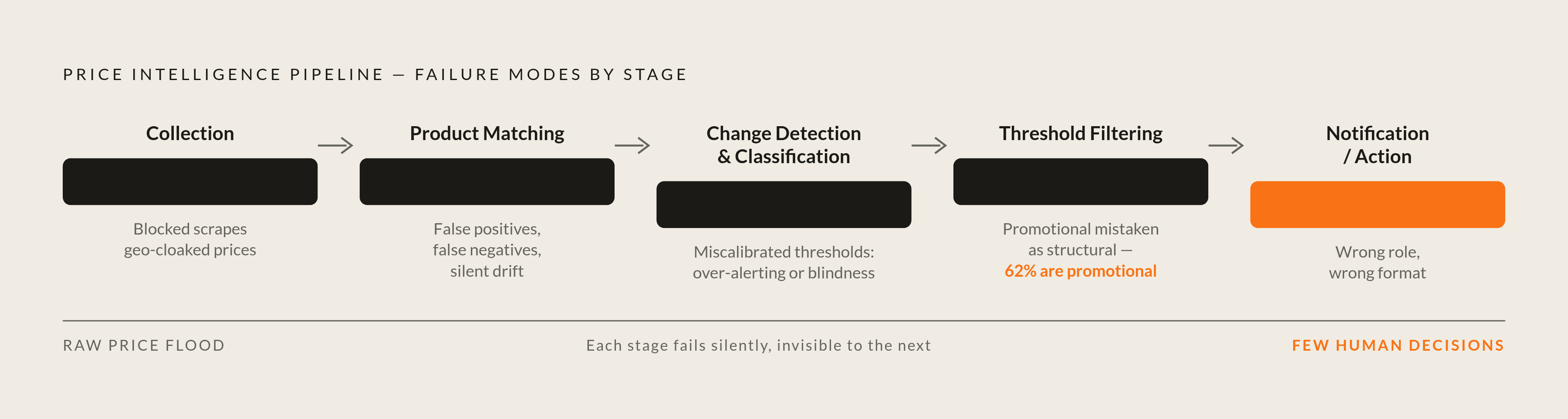
A pipeline runs as a sequence of stages: data collection, product matching, change detection and classification, threshold filtering, then whatever notification or action happens downstream. Each stage breaks in its own way, and a break at any point corrupts everything after it. Accurate scraping means nothing if the matching layer thinks your toaster is a competitor's blender. Good matching means nothing if the thresholds fire on every 2-cent fluctuation until the whole team mutes the channel.
Three layers stack on top of each other. Collection gathers data at the right frequency and from the right geography. Decision compares that data against rules and sorts out what actually changed. Action either reprices automatically or hands a human an exception worth looking at. People stay in the loop at exactly two points: reviewing low-confidence product matches before they enter the feed, and deciding what to do about the handful of changes flagged as genuinely odd rather than routine.
The pipeline's job is to narrow things down, taking a flood of raw price points and squeezing it into the small handful of decisions that need a person's attention at all. Every section after this one describes how that narrowing happens, and where along the way it stops happening.
Choosing a data collection method based on what it will actually cost you
There are three broad ways to collect competitor pricing data, and each trades freshness and coverage against maintenance cost in a different spot.
Direct scraping with frameworks like Scrapy, Puppeteer, or Playwright gives you full control over what gets pulled and how. It also demands real, ongoing engineering time. Diffbot's 2025 Web Data Infrastructure Report found companies running scrapers in-house spend roughly 40% of their data engineering time just keeping them alive, not building new ones. Target sites redesign their HTML, rotate their bot defenses, and generally need constant babysitting to keep a scraper functional at all.
Managed scraping infrastructure, providers like ScrapingBee, Bright Data, or Oxylabs, takes that maintenance off your plate. You still own the extraction logic (you still decide what counts as "the price" on a page showing three strikethrough numbers and a coupon code), but the provider handles proxies, headless browsers, and the arms race against bot detection. Turnkey platforms like Prisync, Price2Spy, or Minderest go further, bundling scraping, matching, and analytics into one product. Fastest to stand up, and the least bendable when your catalog does something weird.
Strip away the sales decks and build-versus-buy is a maintenance question. Custom scrapers break continuously as target sites shift underneath them, and that 40% engineering-time figure is the cost most teams don't see coming until it's already eaten a quarter of their roadmap.
Monitoring frequency should be a category-by-category call, not a default setting. Electronics and fashion move fast enough to need hourly checks; furniture and industrial supplies rarely need more than daily. Some platforms now offer refresh intervals as low as 30 seconds on their higher tiers, and real-time tools can track upwards of 10,000 competitor prices per retailer every minute across channels. Automated repricing reaction times have dropped under two minutes in some setups. But paying for 30-second refreshes does nothing for you if your own repricing approval process takes three days. Match the frequency to the speed your business can act on, not the speed the vendor can technically deliver.
Why anti-bot systems and geo-cloaking are the most common pipeline killers
Here's an uncomfortable fact for anyone building a scraper in 2025: automated traffic passed human traffic on the web for the first time this year, hitting roughly 51% of all traffic according to Imperva's 2025 Bad Bot Report. Every retailer with a pricing page knows this, and most are hardening their defenses right as monitoring demand climbs. Both sides keep upgrading, so nobody wins the arms race; they just keep running it.
Advanced bot-management systems now block up to 82% of automated traffic. Add to that the fact that 94% of modern websites lean on client-side rendering, meaning a plain HTML fetch grabs an empty shell instead of a real price, and you need a headless browser just to see what a human sees on the page. Proxyway's 2025 benchmark measured this directly: Shein averaged just 21.88% scraping success across every provider tested, and G2 averaged 36.63%. Even well-funded operations with dedicated engineering teams miss more than half the data on some targets. That's not a rounding error. That's a coin flip.
Geo-cloaking is the sneakier cousin of outright blocking, because it doesn't fail loudly. Competitor sites often show different prices depending on where the request appears to originate. Without residential proxies matched to the right region, your pipeline can collect a real, confident price that has nothing to do with the market you're actually competing in.
Proxy choice follows its own logic once you see the tradeoffs. Residential proxies buy geo-realism and trust signals, which is what you need against strong bot defenses, at a higher cost per request. Datacenter proxies are cheap and fast, fine for lighter, less defended targets. ISP proxies sit in between. The right choice depends on what specific defenses that specific competitor has put up, which means running this pipeline well means knowing exactly what you're up against, site by site.
The harder failure to catch is the one that never announces itself. A blocked scrape throws an error, which is annoying but at least honest about it. A geo-cloaked price comes back clean and confident and wrong, and nothing in the response flags the difference. Pipelines need validation logic that can tell a missing value apart from a misleading one, because only one of those two failures raises its hand.
A pricing analyst checks maybe 40 to 60 competitor prices an hour on a good day.
Product matching: the layer that determines whether price data is usable
Scraping gets you data. Matching determines whether that data means anything, and it's the layer most teams underinvest in, mostly because it's less visible than a scraper crashing or an alert channel flooding with noise.
Product matching means linking your SKU to the exact same listing on a competitor's site, despite different titles, different identifiers, sometimes different bundle configurations for what is functionally the same product. Sit with this for a second: even a 90% matching accuracy rate means 10 out of every 100 products get compared to the wrong thing. At catalog scale, that's a steady drip of bad repricing decisions nobody traces back to its source, because the dashboard still looks fine the whole time.
Weak matching fails in three distinct directions. False positives happen when your product gets matched to a cheaper, different item, and the repricing engine sees that "lower" price and drops your margin to chase a product you don't actually compete with. False negatives are the mirror image: a real competitor listing never gets matched, so a genuine price move happens out in the world and never shows up in your feed at all. Then there's silent drift, the quietest of the three, where a competitor relists an item under a new title or bundle, the old match breaks, and the feed keeps confidently reporting a stale number as though it were current.
Matching approaches generally get applied in order of what data you actually have on hand. Exact identifier matching using UPC, EAN, or GTIN codes is the gold standard when those identifiers exist on both sides, though they often don't across channels. Fuzzy text matching works when titles are close but not identical. Attribute matching, comparing dimensions, materials, model numbers, helps when titles diverge but the structured specs line up. AI ensemble matching, combining text, computer vision, and attributes, handles the messy multi-source catalogs where the first three approaches all fall short.
AI matching produces confidence scores, not certainties, and that distinction matters more than it sounds like it should. A well-run pipeline routes low-confidence matches to a person for a quick sanity check rather than trusting every algorithmic output blindly. Vendors like to claim accuracy in the low-to-mid 90s, and maybe that's even true on their test set; the gap between a vendor's claimed accuracy and what actually happens on your specific catalog is usually wider than anyone wants to admit during the sales call. BigCommerce's 2025 Technology Accuracy Report found automated scraping hitting 97.8% accuracy on standard product pages, but only 91% on complex pricing structures like subscription tiers or volume discounts. Those complex structures are exactly where a competitor's move is most strategic, and most worth catching.
Setting detection thresholds so the pipeline produces signal, not alerts
Every change detection event should carry the same basic record: current price, previous price, change magnitude in both absolute and percentage terms, direction, and a timestamp. That's the raw material. What you do with it is what separates a useful pipeline from a noisy one.
Threshold design is a noise-reduction exercise, not a setting you configure once and walk away from. Flagging any competitor price drop over 5% on a priority SKU is a reasonable start, but the number should reflect what actually needs a human response, not what your scraper can technically detect down to the cent. Alert on every price change your system can see and you've built an expensive machine for generating anxiety.
The most consequential call the detection layer makes is telling structural changes apart from promotional ones. Deloitte's 2025 Retail Analytics Survey found 62% of competitor price changes in ecommerce are promotional rather than structural, meaning most of what gets detected is a temporary discount, not a permanent repositioning. Treat a Tuesday flash sale like a strategic repricing move and you'll burn repricing budget chasing a price that reverts on its own by Thursday. Worse, you'll train your team to skim past the alert channel entirely, and once people learn to ignore alerts, getting them to trust the channel again takes far longer than the original mistake took to make.
AI agents can now pick up promotional banners, coupon codes, bundle offers, and limited-time labels alongside the raw number, and that context is the real difference between price data and price intelligence. A price alone is a fact. A price plus "this is a 48-hour flash sale tied to a bundle" is something you can act on.
Tiering matters here too. Some changes should trigger automated repricing inside pre-approved rules, no human needed at all. Others belong in a review queue because they cross a threshold but need context a machine can't supply. And plenty of changes belong nowhere near a human, just an informational log kept for pattern analysis later. The test for whether thresholds are calibrated right is almost embarrassingly simple: most alerts should end in a decision. If your team dismisses the majority of what lands in their queue, the thresholds are too sensitive.
Routing alerts to the right people in the right format at the right moment
Automated email and SMS alerts on competitor price changes ship with 88% of major monitoring platforms now, so channel availability stopped being the differentiator a while ago. Anyone can fire off a text message. What matters is what's actually inside it.
A well-built alert packages an impact level (low, medium, high), a short explanation of what changed and why it matters, the specific numbers, some counter-positioning language sales can actually say out loud, and a link to a full battle card, all landing in Slack within minutes of detection. Compare that to the old version: someone notices, someone verifies, someone updates a doc nobody reads until the next sales enablement meeting three weeks later.
Routing by role matters as much as picking the right channel. Merchandising wants price delta and margin impact. Sales wants language they can use on a call without sounding like they're reading off a spreadsheet mid-pitch. Product wants to know about structural shifts, new tiers, dropped features, not routine tactical noise. Send the identical alert to all three groups and you get fatigue across the board, because two-thirds of any given alert is irrelevant to two-thirds of its recipients.
Zapier-style automation chains can take detection straight into AI analysis in seconds: compare the old pricing structure against the new one, flag specific tier changes or dropped discounts or newly added features, and draft the competitive angle sales should run with. What used to take two weeks of Slack threads and half-remembered verbal updates now runs in about two minutes end to end.
This isn't only a fast-moving-catalog problem, either. In SaaS and B2B contexts, pricing might change only a couple of times a year rather than daily, and the instinct is to assume that means the alert layer matters less. Rare changes tend to be more strategically loaded, and a change that happens twice a year but takes two weeks to reach sales is a disproportionate cost relative to how rarely it happens. Low frequency should mean higher fidelity, not lower urgency.
A good alert hands whoever receives it a decision, packaged clearly enough that they can act on it without hunting for more context first.
Where pipelines break in production and how to detect it before it costs you
Every layer above can fail quietly, and quiet failures cost more, because loud failures at least get fixed fast.
At collection, a scraper can get blocked and return nothing, a geo-cloaked page can hand back a confident price from the wrong region, or a cached page can serve stale content that looks fresh. None of these throw an obvious error. They need validation logic checking for expected data shape, not just checking whether something showed up.
At matching, silent drift is the recurring headache: a competitor relists a product under a new name or bundle, the old match sticks around out of pure inertia, and the feed keeps reporting a stale price as current while the pipeline looks completely healthy from the outside.
At detection, miscalibrated thresholds produce two opposite symptoms depending on which way they're off: alert fatigue from too much low-value noise, or alert blindness where a real structural shift falls under the threshold and never gets flagged at all. Same root problem, two different costumes.
At the alert layer, the failure is usually a mismatch: the right detection reaching the wrong role in the wrong format. A pricing analyst gets handed sales talking points they didn't ask for. A sales rep gets a raw price delta with zero context and no idea what to say with it. Both end up tossing aside information that would have been genuinely useful in someone else's hands.
Monitoring the monitor is what catches all this before it costs real money. That means tracking scrape success rates broken out by competitor, watching the distribution of match confidence scores over time rather than just the average, watching alert volume for spikes or sudden drop-offs, and tracking the downstream action rate: if alerts stop turning into decisions, something upstream has quietly degraded. The compounding risk across all four layers is that each failure is invisible to the layer after it, so the whole pipeline can look fully operational while feeding wrong numbers into repricing decisions for weeks straight. A periodic manual spot-check against a handful of known competitor prices remains the simplest, cheapest audit you can run, and it's the one most teams skip because everything on the dashboard looks fine.
Tooling options across the build-buy-integrate spectrum
The build-buy-integrate call shouldn't get made once for the whole pipeline. It should get made once per layer, because each layer has its own bottleneck. A team might use a managed scraping API for collection, a SaaS platform for matching and detection, and a custom webhook setup through something like Zapier for alert routing. Mixing across layers is usually the correct architecture, not a compromise.
Turnkey platforms like Prisync, Price2Spy, and Minderest bundle collection, matching, and basic alerting into a single product. Fastest path to something running, and the tradeoff shows up the moment your catalog does anything nonstandard or your routing logic gets specific. Managed scraping providers, Bright Data, Oxylabs, and ScrapingBee among them, solve specifically for the anti-bot and proxy problem, which is the right call when collection is your actual bottleneck and your team has bandwidth to build matching and alerting on its own. AI-native competitive intelligence platforms push further, reaching past price into positioning, messaging, and battle card generation, useful when the alert layer needs to hand sales something ready to say out loud rather than a bare number on a screen.
When evaluating any of these, the feature list matters less than three questions vendor decks tend to gloss over. What's the matching accuracy on your specific catalog, not the vendor's demo catalog? How does the tool handle anti-bot failures: does it flag the gap honestly, or quietly report silence as though it were data? And does the alert output slot into your team's existing workflow, or does someone have to manually reformat it every single time it lands?
The competitor price monitoring market was valued at roughly $1.2 billion in 2024, with projections putting it near $2.5 billion by 2033 at a 9.2% compound annual growth rate. A market growing that fast throws off new entrants and overlapping features faster than anyone can fairly sort through. Build the architecture so no single layer locks you in. The tool you pick this year probably isn't the best option in this category three years from now, and the pipeline that survives is the one built to swap parts, not the one built around a single vendor's roadmap.
Sources
- https://www.clymin.com/resources/competitor-price-monitoring
Provided the 15%–25% weekly catalog price-change rate figure and the statistic that 62% of competitor price changes are promotional rather than structural.
- https://tendem.ai/blog/price-scraping-competitor-monitoring-guide
Provided the competitor price monitoring market size figures of $1.2 billion in 2024, $2.5 billion projected by 2033, and the 9.2% CAGR.
- https://www.joinmassive.com/blog/competitor-price-monitoring
Provided the Imperva 2025 Bad Bot Report statistic that automated traffic reached 51% of all web traffic.
- https://ustechautomations.com/resources/blog/automate-competitor-price-monitoring-repricing-ecommerce-2026
Provided the Gartner survey finding that the average brand monitors only about 12% of its catalog, refreshed once every 14 days.
- https://tendem.ai/blog/competitor-price-monitoring-guide
Provided the statistic that advanced bot-management systems block up to 82% of automated traffic, and the routing-by-role guidance for alert delivery.
- https://blog.9cv9.com/top-50-competitor-price-monitoring-software-statistics-data-trends-in-2025/
Provided the figures that in-house scraper maintenance consumes roughly 40% of data engineering time and that real-time tools can track upwards of 10,000 competitor prices per retailer every minute.
- https://brightdata.com/blog/web-data/best-web-scraping-apis
Provided Proxyway 2025 benchmark success-rate figures: Shein at 21.88% and G2 at 36.63% scraping success across providers.
- https://www.browserbase.com/blog/best-web-scraping-tools
Provided the statistic that 94% of modern websites rely on client-side rendering, requiring a headless browser to retrieve actual page content.