Proxy Rotation Strategies for Large-Scale Browser Automation
Match your proxy type and session strategy to what the target site actually defends.
Proxy rotation is not a single trick you bolt onto a scraper. It is a family of decisions, and the right answer depends on what the target site protects, what your automation actually needs to remember between requests, and how much you're willing to spend to look boring. That's the whole piece, really: matching proxy type and session behavior to the job in front of you, rather than reaching for whatever pool your last project used.
Browser automation stopped being a matter of downloading HTML a while back. Most valuable targets today run JavaScript-heavy single-page apps, gate content behind login, and defend themselves with real-time detection engines that were not around ten years ago. Bot detection now covers most enterprise websites, and bots make up roughly half of all web traffic; those two facts are on a collision course, and your IP address sits right at the impact point. Burn it on a protected target without a rotation plan, and you can lose it within hours. Zyte's 2025 State of Web Scraping report put it plainly: rotating proxies aren't an advanced tactic anymore, they're what most data professionals consider baseline infrastructure. So let's build the decision framework instead of another product comparison.
The four proxy types and what each one actually trades off
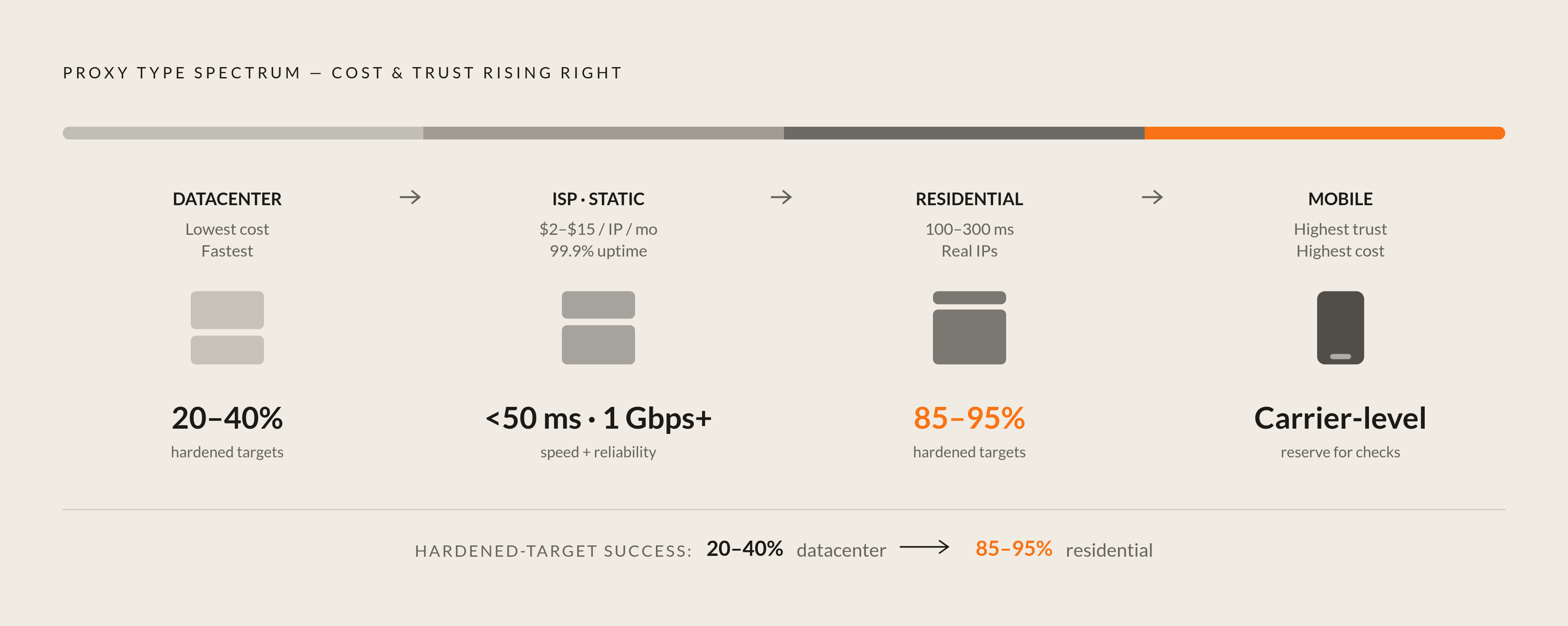
Four categories exist, and they line up neatly on a spectrum from cheap-and-fast to slow-and-trusted: datacenter, ISP (static residential), residential, and mobile. Cost and stealth rise together, more or less in lockstep.
Datacenter proxies live on cloud infrastructure with no tie to a real household or ISP. They're the fastest option and the cheapest, especially in shared pools, but that same shared-pool economy means multiple clients hit the same IP, which raises ban risk. On heavily protected e-commerce, social, or streaming targets, expect success rates in the 20 to 40 percent range. That's fine on a site with no real defenses. It's unreliable everywhere else. Datacenter proxies make sense for high-volume, stateless scraping of low-protection targets, where speed and price matter more than blending in.
Residential proxies flip the trade. These are IPs assigned by real ISPs to real homes, so a target site sees what looks like a genuine visitor. Bandwidth typically runs 10 to 100 Mbps with latency between 100 and 300 milliseconds, noticeably slower than datacenter, but success rates on the same hardened targets jump to 85 to 95 percent. Where those IPs actually come from matters more than most buyers realize. The Badbox 2.0 disruption, a 2025 joint effort between Google and HUMAN Security, exposed roughly a million malware-infected Android devices being resold as residential proxy exits. Route through an unvetted pool and you might unknowingly be running your scraper through somebody's compromised smart TV. Sourcing transparency isn't a nice-to-have here; it's the first question worth asking any provider. On the scale end, Bright Data runs more than 72 million residential IPs across 195 countries, and Oxylabs claims over 100 million.
ISP proxies, sometimes called static residential, split the difference: a residential ASN number that makes the IP look like a home connection, but hosted on datacenter hardware for speed. You get 1 Gbps-plus throughput with latency under 50 milliseconds, three to ten times faster than rotating residential, at similar legitimacy for basic to moderate protection. The IP is fixed and dedicated, providers advertise 99.9 percent uptime SLAs, and pricing runs $2 to $15 per IP per month. The ceiling is real, though: advanced fingerprinting can spot the datacenter hardware sitting behind that residential-looking ASN. Fine against basic and moderate security, not against cutting-edge machine-learning detection. ISP proxies fit workflows that need a persistent identity and fast connections, like account management or long authenticated sessions.
Mobile proxies sit at the top: IPs from actual carrier networks, the hardest tier to block and the most expensive by a wide margin. Bright Data expanded its mobile network past 10 million IPs in late 2025. Most workflows don't need this. Reserve mobile proxies for targets that specifically fingerprint mobile versus desktop traffic or run carrier-level trust scoring; paying mobile prices for a task that datacenter could handle wastes budget without adding protection.
Shorthand worth keeping on a sticky note: basic sites, go datacenter. Moderate protection needing stable sessions, go ISP. Advanced anti-bot with fingerprinting, go residential. Carrier-level trust checks, go mobile.
Rotating vs. sticky sessions — the choice that determines whether a workflow succeeds or fails
Here's the fork in the road that trips up more automation projects than proxy type ever does. Rotating sessions hand out a fresh IP on every request. Sticky sessions lock you to one IP for a set window, usually somewhere between 1 and 30 minutes depending on the provider.
Per-request rotation spreads your traffic across the whole pool, so no single IP takes enough volume to trip a rate limiter. It's the right call for parallel, stateless work: product catalog crawls, search results collection, any job where each request stands on its own. Run 50 concurrent threads, each on a different IP, and the target site sees 50 separate visitors instead of one very busy one.
Sticky sessions exist because some tasks simply can't survive an IP swap mid-stream. Logging into an account, working through a multi-step form with CSRF tokens, paginating through a query that's bound to your IP, or completing a checkout where the cart state is IP-validated: all of these need the site to see one consistent visitor from start to finish. There are two ways to implement this. Port-based stickiness binds one IP to one local port; simple, but it doesn't scale past a handful of sessions. Session-ID-based stickiness passes a token in the proxy username so the gateway routes matching requests to the same IP, which scales to hundreds of concurrent sessions from a single endpoint.
The risk with sticky sessions is that you're burning through a single IP the entire time. On a high-volume, stateless target, the longer that session runs, the more exposed it is. Choosing wrong in either direction doesn't degrade gracefully: rotate mid-login and you break the flow outright; stay sticky on a stateless, aggressive target and you exhaust one IP while the rest of your pool sits idle.
The practical answer, for a lot of workflows, is a hybrid: authenticate with a sticky session, then switch to rotation once you're past login and just pulling data. Continuity where the task demands it, anonymity everywhere else. Apify's SessionPool abstraction is one existing tool that manages sticky sessions across concurrent requests without forcing you to hand-roll session-ID tracking, worth a look if you're building on top of an existing framework rather than from scratch.
Matching proxy type and session strategy to specific automation use cases
High-volume public data collection, think product pricing, search rankings, news feeds, pairs naturally with per-request rotation. Proxy type depends on target hardness: datacenter if the site barely defends itself, residential if it runs moderate anti-bot measures. Start a pool at 50 to 100 IPs and scale from there based on what your success rate actually tells you.
Authenticated account scraping is a different task entirely. Social platforms, e-commerce dashboards, SaaS tools, all of these need you to pass as a genuine logged-in user, which points to residential or ISP proxies with sticky sessions held for the authenticated window. Running many accounts in parallel means leaning on session-ID-based stickiness rather than trying to manage ports by hand. One case worth noting: a global e-commerce brand running over a million rotating IPs daily achieved a scrape success rate above 95 percent, and that kind of number doesn't come from pool size alone. It comes from deliberate session management layered on top of scale.
Multi-step form automation and checkout testing need ISP or residential proxies, held sticky for the entire transaction. CSRF tokens and cart state are IP-sensitive, full stop, and even a brief mid-flow IP swap invalidates the session and forces a restart. There's no partial credit here.
Geo-specific content verification, like ad verification or checking geo-restricted content, calls for residential proxies with geo-targeting so the traffic looks like a genuine local user in a specific country or city. Session strategy depends on the check itself: sticky if you need consistent locale attribution across a multi-page test, rotating if each check stands alone.
AI training data collection deserves its own mention because the defenses have gotten sharper. Sites protecting training-quality content increasingly run per-site machine-learning detection, and Cloudflare's mid-2025 data attributed roughly 80 percent of AI bot activity to a small set of identifiable sources, meaning these targets are under active, sophisticated watch. Residential proxies are the baseline here, and session diversity matters more than on a typical scraping job. A hybrid approach with deliberately varied session lengths helps avoid the kind of temporal pattern that gives away automated behavior.
Datacenter proxies live on cloud infrastructure with no tie to a real household or ISP.
What modern anti-bot systems actually detect — and why IP rotation alone is not enough
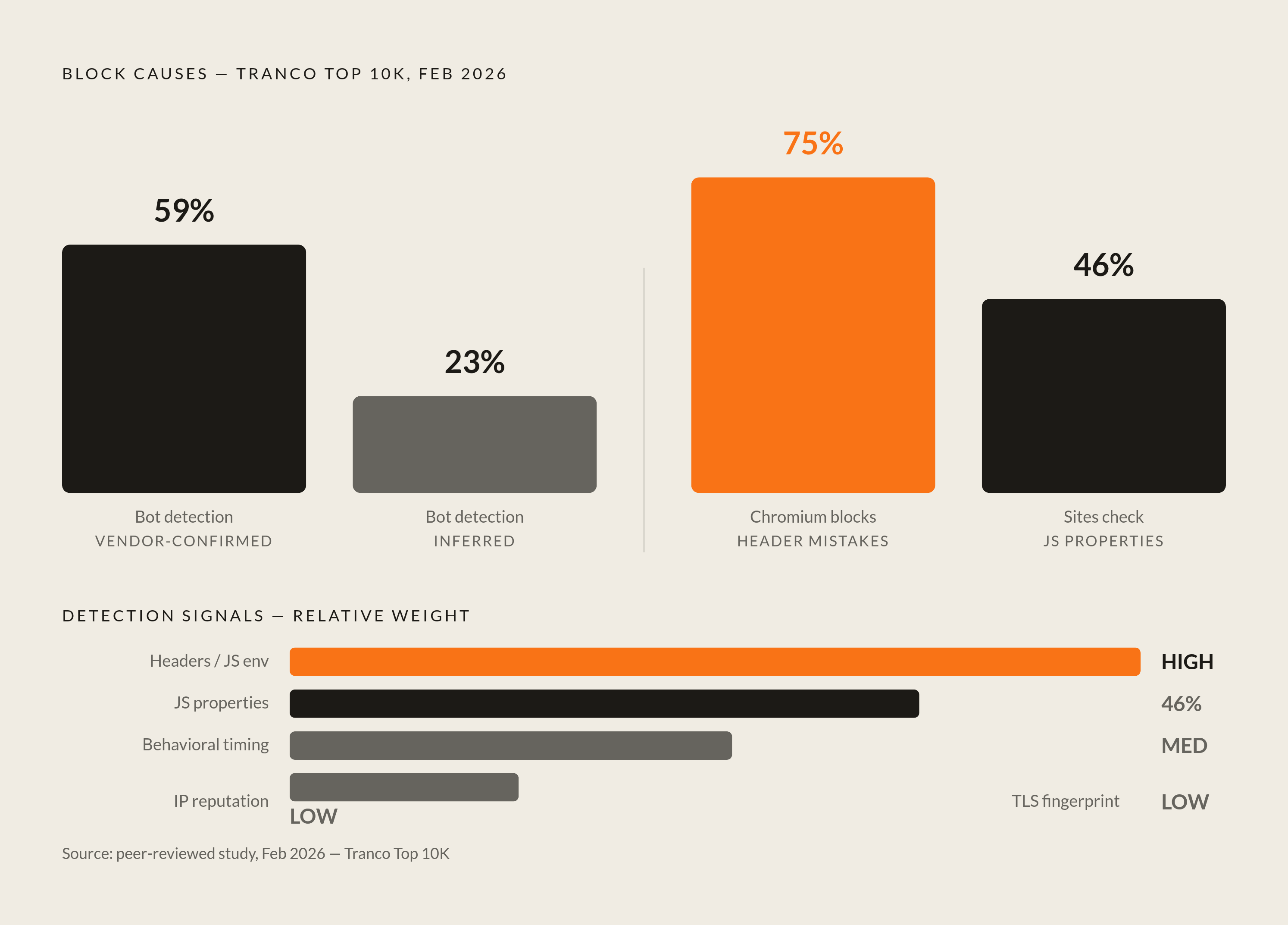
Here's the uncomfortable truth that a lot of rotation-first strategies miss: IP reputation is just one signal among several running at once. Modern anti-bot systems fingerprint TLS handshakes, inspect the browser environment, watch request timing, and cross-check headers, all simultaneously, all in real time.
A February 2026 peer-reviewed study of the Tranco Top 10K sites found that 82 percent of blocks trace back to bot detection systems, split between 59 percent vendor-confirmed and 23 percent inferred from condition-dependent blocking behavior. Cloudflare accounted for 37 percent of block rate in that dataset, Akamai for 26 percent. And header-level mistakes alone caused 75 percent of Chromium-headless blocks; 46 percent of sites check for JavaScript properties that only exist in automated browsers. Rotating your IP fixes none of that. You can cycle through a thousand clean addresses and still get flagged on the very first request if your headers don't match a real browser.
TLS fingerprinting moved the goalposts again by 2026, with JA4 replacing the older JA3 standard across Cloudflare, AWS WAF, VirusTotal, and Akamai. Chrome's TLS extension randomization, in place since version 110, already made JA3 unreliable as a signal; tooling still leaning on JA3 spoofing is working off an outdated map.
Behavioral consistency trips up a surprising number of otherwise well-built scrapers. A request claiming sec-ch-ua-platform: "Windows" while presenting a macOS User-Agent string is an instant fail on DataDome and comparable systems. Rotate your IP constantly while keeping one static browser fingerprint, and you've created a different kind of red flag: the same digital fingerprint showing up from dozens of IPs looks exactly like what it is. Perfectly uniform request timing triggers behavioral scoring even when everything else checks out clean, because real humans don't click at metronome intervals. And in Playwright or Puppeteer setups, DNS or WebRTC leaks can expose the real IP sitting behind your proxy, which defeats the entire point of rotating in the first place.
The defenses keep adapting, too. DataDome runs more than 85,000 customer-specific machine-learning models, meaning every protected site is its own distinct puzzle rather than one universal rule set to crack. Cloudflare's bot-detection system analyzes north of 46 million HTTP requests per second, scoring traffic from 1 to 99 so site operators can decide where to draw the line between allow, challenge, and block. Cloudflare's AI Labyrinth, deployed in March 2025, plants fake pages laced with hidden links; any automated client that follows one gets flagged with high confidence, which means an aggressive rotation strategy that dutifully clicks every link it finds is speeding toward detection, not away from it. Cloudflare began blocking AI-based scraping by default that July.
Put plainly: a rotation strategy that ignores fingerprint consistency loses to a well-configured static session more often than you'd expect. Proxy choice and browser environment hygiene are two halves of the same job, not separate concerns.
Building and maintaining a proxy pool that holds up under sustained load
A provider selling a "20 million IP pool" is quoting inventory, not availability. On any given day, only a fraction of those addresses are actually active; providers cycle IPs constantly to keep the pool healthy and prevent overuse. Light workloads run fine on a few dozen IPs. Heavier operations typically start around 50 to 100 and scale from there based on observed results. When evaluating a provider, ask about active daily availability. Total pool size is a marketing number.
Past 50 or 100 IPs, tracking health by hand stops being realistic, and automated scoring becomes necessary rather than optional. Two metrics matter most: success rate and latency, weighted roughly as success rate times 0.6 plus a latency score times 0.4, a formula that leans slightly toward reliability over raw speed. Set thresholds and let the system act on them: quarantine anything scoring below 70 for review, and route critical requests through anything above 85 first. Monitoring probes checking pool health every 15 minutes across representative target sites, not just basic connectivity pings, catch problems before they compound.
Plain round-robin rotation, one IP per request in strict sequence, is sometimes worse than doing nothing at all. A pageview arriving from a brand-new IP every single time, with zero session context behind it, is itself a detectable pattern, since the whole point of rotating was to avoid looking like a pattern in the first place. Smarter rotation varies session duration, adds human-like timing jitter, and weights IP selection by each proxy's historical success on that specific domain. Score-weighted selection, where probability of use scales with health score, concentrates your cleanest IPs on the requests that matter most.
Watch your failure signals closely, and don't assume every spike means the same thing. A sudden jump in block rate might be a rate limit, or it might be something like Cloudflare's AI Labyrinth quietly flagging your crawler through a honeypot page; the fix for the second problem is auditing your crawl path, not just swapping IPs and hoping. Track success rates per domain rather than in aggregate, since a pool performing beautifully on one target class can be thoroughly burned on another without the overall number moving much.
And circle back to sourcing, because it's an operational risk as much as an ethical one. Unvetted residential pools carry real botnet contamination risk, as Badbox 2.0 demonstrated. Providers with documented sourcing practices and clear opt-in models for their residential IPs are worth the extra scrutiny during vendor selection; the alternative is finding out the hard way whose device you were routing through.
Choosing a platform that integrates proxy rotation with browser automation at scale
Everything above, proxy type, session strategy, fingerprint hygiene, pool health, has to work together inside whatever browser automation platform you're actually running. A residential proxy pool paired with sloppy header management solves nothing. A perfectly weighted rotation logic paired with a browser that leaks its real IP through WebRTC solves nothing either.
The practical question when evaluating a platform is whether it treats proxy rotation and browser fingerprinting as one integrated problem or two separate bolt-on features. Does session management (sticky where needed, rotating where it isn't) happen natively, or does your team have to wire that logic by hand for every workflow? Does the platform manage TLS fingerprint consistency alongside IP assignment, so a rotating IP doesn't leave a static, mismatched browser signature trailing behind it?
Scale changes the calculus too. Running a handful of scrapers is one thing; running the equivalent of that million-IP-a-day e-commerce operation mentioned earlier is another, and it requires infrastructure that automates health scoring, quarantines bad IPs without a human watching a dashboard, and adjusts rotation logic per target domain rather than applying one blanket policy everywhere. The teams getting 85 to 95 percent success rates on hardened targets aren't doing so because they picked the single best proxy provider. They're doing it because proxy type, session strategy, and browser hygiene were designed together from the start, with the platform doing the coordination rather than a person stitching it together request by request.
Sources
- https://use-apify.com/blog/rotating-vs-sticky-proxy-sessions
Provided the description of Apify's SessionPool abstraction for managing sticky sessions across concurrent requests.